
Not only do you need an effective and independent regulator, you also need competition to flourish.

India will need an annual investment of Rs 15 trillion in infrastructure over the next five years, says Chandrajit Banerjee, DG, CII.

IMF attributes the slower growth rate to supply-side bottlenecks.

'There is no need to do anything, let your SIPs get deducted every month, and stick to your allocation between equity, fixed income and emergency funds and your risk covers.'

The sudden exit of Yogesh Agarwal as the chairman of the Pension Fund Regulatory and Development Authority, or PFRDA, has once again brought the relationship between financial sector regulators and the finance ministry into sharp focus.

AAP has promised lower electricity bills, free basic water supply.
The 30-share Sensex ended down 71 points at 26,710 and the 50-share Nifty lost 38 points to close at 8,030.

If the central banks act harshly now, the markets will crash and then rally. If they are hesitant, the pain will be prolonged, predicts Debashis Basu.
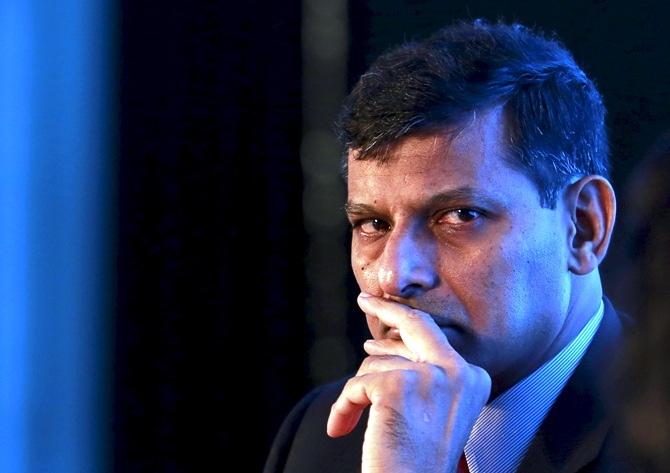
We need a change in mindset, says the RBI Governor.

The focus of the Union Budget is on providing basic amenities to the poor, middle class and youth, Prime Minister Narendra Modi said on Wednesday, and asserted that it is imperative that India becomes self-reliant.

The RBI cut rates for third time in 2015 due to favourable economic conditions.
Yashwant Sinha explains where the Modi government has gone wrong in its handling of the economy.

'Economic issues do not matter during elections; it is the emotional connect that helps swing votes.'

'Investors should be careful in getting carried away; although a reversal of IPO frenzy this time is taking longer than in the past.'

Investment banking star and Moelis India Chief Executive Officer Manisha Girotra remembers a colleague who wanted to resign because she needed to attend to her parents' health issues in a different state. Rather than quit a promising career, she was given the flexibility of working from home on Fridays, which was unusual in the pre-pandemic days. This allowed her to take care of her parents' visits to the doctor and other health-related needs without quitting her job. She would be back in the city office on Mondays.
Risk sentiment received a boost after eight core sectors grew to a five-month high of 4.9 per cent in August

It is imperative to check the basics of a company before investing in it

'The Budget has maintained fiscal prudence while announcing a number of steps to boost growth, particularly in infrastructure and rural sectors.'

Richest Indian Gautam Adani's ports-to-power-to-cement conglomerate is "deeply overleveraged" with the group predominantly using debt to invest aggressively across existing as well as new businesses, CreditSights, a Fitch Group unit, said on Tuesday. In a report titled 'Adani Group: Deeply Overleveraged', CreditSights said, "In the worst-case scenario, overly ambitious debt-funded growth plans could eventually spiral into a massive debt trap, and possibly culminate into a distressed situation or default of one or more group companies." Starting out as a commodities trader in the late 1980s, the Adani group has diversified from mines, ports and power plants into airports, data centers and defence.

'All of Indira Gandhi's bad economic ideas are being strengthened, from nationalised banks to anti-poverty, handout yojanas,' says Shekhar Gupta.

India's GDP is estimated to contract by a record 7.7 per cent during 2020-21 as the COVID-19 pandemic severely hit the key manufacturing and services segments, as per government projections released on Thursday. Amid overall decline in economic activities, some respite was provided by the agriculture sector and utility services like power and gas supply, which have been projected to post positive growth during the current fiscal ending March 2021.

The BSE Sensex gained 104.63 points to end at 33,147.13, while the broader Nifty spurted 48.45 points to finish at 10,343.80.

Benchmark indices finished higher on hopes of economic reforms

'Gloom is nowhere in sight, with healthy foreign exchange reserves, a strong rupee, healthy tax collections, corruption and crony capitalism under check,' argues Gopal Krishna Agrawal.

The prospects for strong, sustained economic reforms do not appear to be promising in India.

Delivering a public speech hours after the RBI launched a rescue act for Yes Bank on March 6, Governor Shaktikanta Das reiterated the RBI's affirmation to do whatever was needed to combat the coronavirus impact. On that day, India had only one confirmed COVID-19 infection, the World Health Organisation was five days off from declaring it as a pandemic and the financially debilitating lockdowns were not even on the horizon. Das' promise on efforts to mitigate COVID-19 impact appeared as a footnote in news reports from the event.

The FPI holding in India's top 100 companies, which are part of the Nifty 100 index, declined to 24.23 per cent on average at the end of March this year, from a high of 27.5 per cent at the end of March 2021. This is the lowest FPI holdings in India's top listed companies in at least three years. A general sell-off by FPIs has weighed on stock prices and the benchmark S&P BSE Sensex is down 8.5 per cent, from its 52-week high made in October 2021. Most analysts expect FPI flows to remain weak in FY23 as well, given rising bond yields in the US and an expected earnings slowdown in India due to high inflation and commodity prices.

India Ratings expects long products demand growth to be sharp, supported by a demand push from the government-led infrastructure investments in affordable housing, railways, rural electrification and road networks.

The BSE 30-share index after a positive opening stretched to 31,772.41, but could not stay there for long buffeted by the selling pressure. It hit a low of 31,562.25 before settling lower by 79.68 points, or 0.25 per cent, at 31,592.03.

'No Budget has so far has addressed the issue of the government's abysmal productivity of capital spending, improving which will be the big game changer. 'But, the government's tight lock on businesses, banks, education, and even essential services like transportation and large parts of infrastructure and healthcare is destroying capital year after year,' points out Debashis Basu.

In 2015, the Reserve Bank of India cut interest rates by 125 basis points to 6.75 per cent.

Stepped up public expenditure must be accompanied by focused policies, advises Vinayak Chatterjee.

The government has provided a long-term vision.

You will need a sharper eye for stock picking and a greater appetite for risk than most retail investors possess, recommends T N Ninan.

'Largely, new demat accounts are now being opened by the younger crowd, particularly GenZ.' 'This is great news since younger investors start their journey with very little capital, so they are risking less.'

The 30-share Sensex surged 299 points to close at 28,736 and the 50-share Nifty gained 90 points to end at 8,723.

Learning perhaps from the Kargil debacle, Musharraf tried hard to evolve as a statesman in his dealings with India, recalls Rana Banerji, who headed the Pakistan desk at RA&W.

Auto stocks are weighing on the indices.

Wang began a two-day trip to Pakistan on Tuesday primarily to attend a meeting of the Council of Foreign Ministers of the Organisation Islamic Cooperation (OIC) as a special guest.

Stock market minnows put up a stellar show in 2021 giving returns of up to 60 per cent amid Dalal Street dream run and are likely to continue sailing northwards in the New Year too. Trumping pandemic-induced uncertainties, the Indian equity market posted stunning gains this year achieving several feats and smaller stocks benefited the most from the strong momentum. From reaching the momentous 50,000-mark in January to scaling 61,000-level in October, the BSE Sensex had an epic journey this year.
